Cart
0
Key facts
- "Single-origin" means every peppercorn in the pouch was grown in one place, not pooled from several countries. It tells you where, not how good.
- Black pepper starts as green berries on a vine. Sun-drying turns them black through enzyme and pigment changes in the skin.
- Whole spices keep their flavor about twice as long as ground ones, according to a US university extension service (about two years against about one).
- Ground black pepper has a documented history of being bulked out with ground papaya seed, which is why researchers built tests to catch it.
Most people buy pepper by habit: a grinder on the table, a tin in the cupboard, the word "pepper" on the label and nothing else. Single-origin peppercorns ask a different question: where, exactly, did this come from? Here is what that phrase does and does not mean, how pepper becomes pepper, and what to check when you buy.
What "single-origin" actually means
Single-origin means all of the peppercorns in a pouch were grown in one country, ideally one region, and traveled together. A blend can pool lots from several countries into one product. A label that says only "black pepper" tells you the spice, not the place it was grown.
It is worth being clear about the limits. Origin is not a grade, a variety or a quality score on its own. A single-origin pepper can be excellent or ordinary; what you gain is traceability, meaning you can ask where it came from and get an answer. Sri Lanka's national export board markets its pepper under the name "Ceylon pepper" as a distinct origin.
How a peppercorn becomes black pepper
Green, black and white pepper are the three main types on the market, and all come from the same plant, Piper nigrum; they differ in how the berries are picked and processed. For black pepper the berries are dried whole, often in the sun. As they dry, the green skin darkens. A 2018 study of four traditional processing methods found that this blackening comes from several changes at once: an enzyme (polyphenol oxidase) acting on phenolic compounds, plus the breakdown of chlorophyll and vitamin C in the skin. The authors note that blackening contributes to both the color and the flavor of the finished pepper.
The practical takeaway: how the berries are picked and dried shapes the pepper you get, which is one more reason to know who handled it and where.
Why whole peppercorns beat pre-ground
Cracking or grinding a spice releases aroma compounds that were locked inside it. The test kitchen at Milk Street compared a curry made with whole spices against the same curry made with ground spices and preferred the whole-spice version, and it recommends buying whole spices in small quantities and grinding them as needed. NDSU Extension puts numbers on shelf life: most ground spices keep their flavor for about one year, while whole spices keep theirs for about two.
There is a second reason, and it is about honesty rather than flavor. Ground pepper is a powder, and a powder hides what is in it. Scientists have published methods for detecting ground papaya seed mixed into black pepper powder, because that adulteration is a known problem. A whole peppercorn is easier for you to look at and smell. That second point is our own reasoning, not a study finding, and whole pepper is not immune from fraud, but you can at least see what you are buying.
What to look for when you buy single-origin peppercorns
- A country on the label. "Packed in the USA" is not an origin. Look for where the pepper was grown.
- Whole, not ground. You can inspect them and grind only what you need.
- Dark, wrinkled, fairly uniform berries that smell sharp and warm when you crush one. A dusty, faint smell suggests old stock.
- Certifications you can verify. A USDA Organic claim should come with a certifier and an ID you can look up.
- Documentation, honestly described. Ask what testing exists and what it covers: which product, which lot, which contaminants.
- A small pouch you will finish. Spices come from far-flung places and can be a year or two old by the time they reach the shelf, so buy small quantities.
How to use whole peppercorns
- Grind at the table over eggs, pasta, soups and salads so the aroma is at its peak when it hits the food.
- Crack them coarsely for steak, roast vegetables and marinades. Milk Street notes that peppercorns are better cracked or coarsely ground than eaten whole.
- Toss a few whole into stocks, brines, rice and chai so they perfume the pot, then fish them out.
- Pair with turmeric in golden milk and curries; see our guide on why the two are sold together.
Whole black peppercorns from one origin
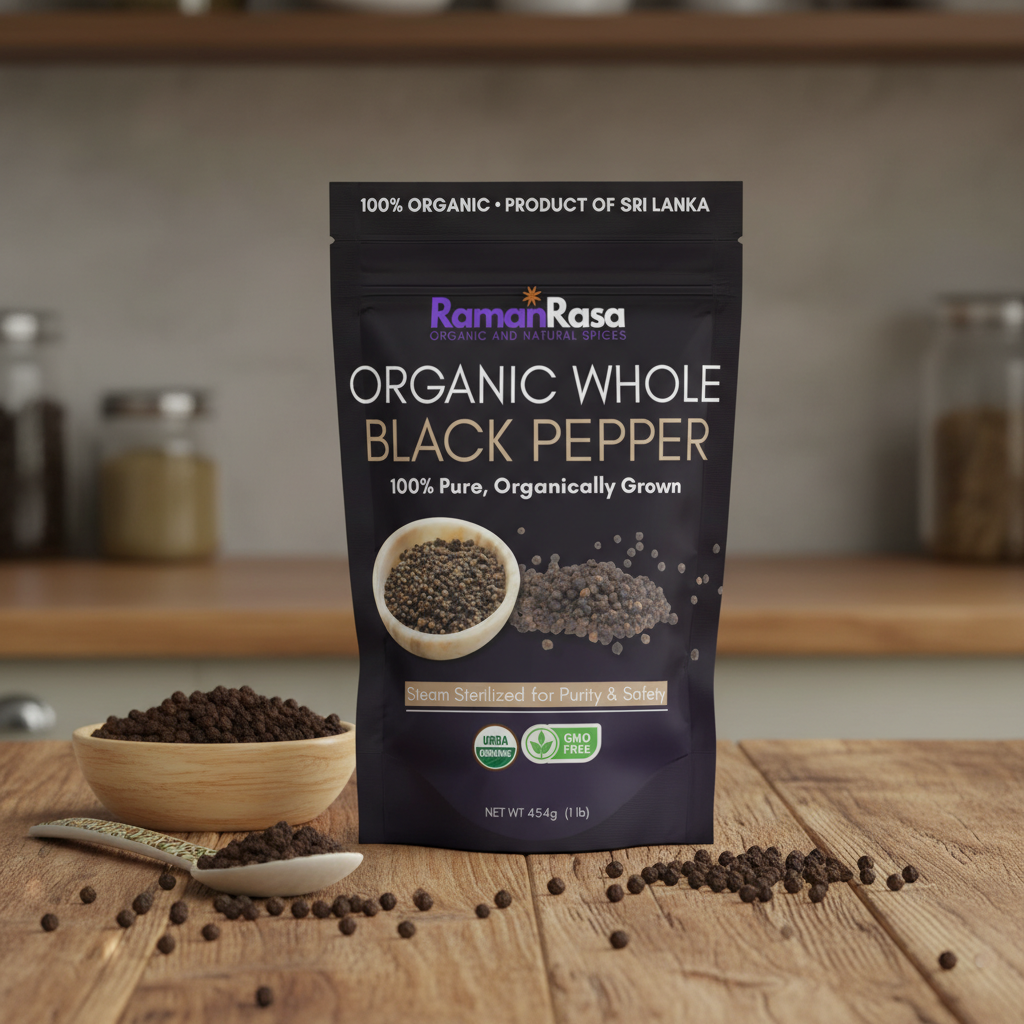
Our organic whole black pepper is single-origin from Sri Lanka, hand-picked and sun-dried whole, sealed in the pouch at origin, and shipped from our Houston facility. USDA Organic (NOP ID 5561009364, certified by CCOF), Fair Trade Certified, GMO Free. It is sold out right now; the next batch arrives in Houston on October 17.
What we can tell you about testing today: an independent accredited laboratory (GBA, Hamburg) tested a supplier sample of organic whole black pepper for pesticide residues in 2026 and found none detectable. That was a supplier sample and covered pesticide residues only; it is not a result for a specific pouch. Independent per-batch testing is planned, with results published once each batch is in our Houston facility.
FAQ
Is single-origin pepper better than blended pepper?
Not automatically. Single-origin means you know where it was grown, which makes it easier to trace and to compare year to year. Flavor still depends on how the pepper was grown, picked, dried and stored.
What is the difference between black, white and green peppercorns?
They come from the same plant and differ in how the berries are picked and processed. Black pepper is dried whole until the skin darkens.
Do whole peppercorns go bad?
They lose aroma over time rather than spoiling quickly. NDSU Extension says whole spices keep their flavor for about two years when stored in tightly covered containers in a cool, dry, dark place, and that ground spices keep theirs for about one year.
Should I buy pre-ground pepper?
If you cook with pepper often, a small grinder and whole peppercorns give you a fresher result and let you see what you are buying. Pre-ground is fine for convenience, as long as you use it within about a year.
Related reading
- Why Turmeric and Black Pepper Are Always Sold Together — the science behind the pairing
- Why Whole Cloves Lose Potency Fast and How to Keep Yours Fresh — storage tips that apply to whole peppercorns too
- How to Read a Spice Certificate of Analysis (COA) — what a real lab report looks like and what to ask any spice brand
Sources
- Gu, F. et al., Contribution of Polyphenol Oxidation, Chlorophyll and Vitamin C Degradation to the Blackening of Piper nigrum L., Molecules 23(2):370 (2018)
- A new TLC method to detect the presence of ground papaya seed in ground black pepper, Journal of the Science of Food and Agriculture 81(14):1322-1325 (2001), via FAO AGRIS
- Garden-Robinson, J., Spice Up Your Menus, Prairie Fare, NDSU Extension, February 9, 2012
- Card, M., When to Use Whole Spices vs. Ground Spices, Christopher Kimball's Milk Street, April 2022
- Where does black pepper come from? FAQs on Ceylon Spices, Sri Lanka Export Development Board