

Cart
0
Key facts
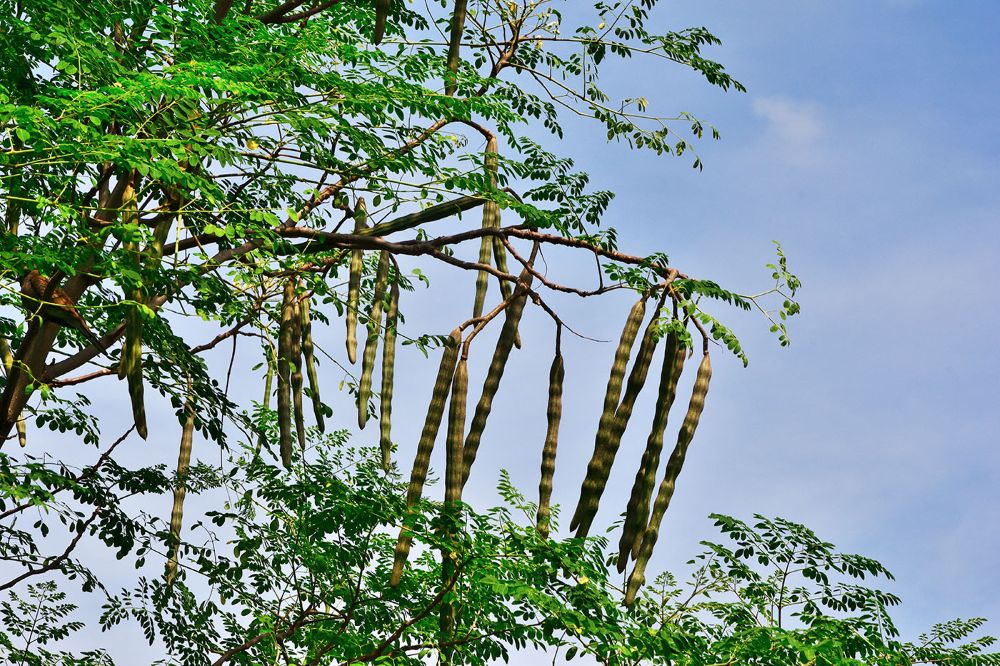
- Moringa oleifera is a fast-growing tree. The part sold as powder is its leaves, dried and milled.
- It is a long-standing food crop across South Asia and parts of Africa — the pods are eaten as a vegetable (drumsticks) and the leaves are cooked into everyday dishes. It is not a new discovery.
- Per 100g raw, the leaves provide 9.4g protein, 4.0mg iron, 185mg calcium and 51.7mg vitamin C — genuinely nutrient-dense for a leaf.
- It tastes mild and grassy, closer to matcha or a green tea than to a strong herb — which is why it disappears easily into smoothies, dals and dressings.
Moringa turns up on shelves as a bright green powder with a lot of claims attached to it. The plant behind it is considerably less exotic than the marketing suggests, and more interesting.
What moringa actually is
Moringa oleifera is a fast-growing tree, sometimes called the drumstick tree after its long seed pods. Nearly all of it gets used: the pods are cooked as a vegetable, the leaves are eaten fresh or dried, and the seeds are pressed for oil.
What's sold as "moringa powder" is the leaves — harvested, dried, and milled into a fine green flour. That's the whole process. There's no extraction or concentration step beyond removing water.
Where it comes from
Moringa grows across tropical and subtropical regions and has been a working food crop — not a wellness product — in South Asian and African cooking for a very long time. In Sri Lanka, where ours is grown, the leaves go into curries and dals as an ordinary ingredient.
That matters for one practical reason: like any leafy crop, what ends up in the powder depends on the soil it grew in and how it was processed after harvest. Origin isn't a marketing detail here, it's the thing that determines what you're actually eating.
What the nutrition data shows
Per 100 grams of raw leaves, USDA FoodData Central lists 9.4g protein, 4.0mg iron, 185mg calcium and 51.7mg vitamin C. For a leafy green, that is a strong profile — moringa is more nutrient-dense than spinach on each of those measures.
Two honest caveats worth holding onto:
First, those figures are for 100 grams of raw leaf. A serving of powder is about a teaspoon — roughly 2 grams. Moringa is a useful addition to a meal, not a substitute for eating vegetables.
Second, you'll see much larger comparisons quoted — "25 times the iron of spinach" and similar. Those compare dried powder against fresh produce, which isn't a like-for-like comparison. We went through the real numbers in moringa vs. spinach.
What it tastes like, and how people use it
Mild, slightly grassy, closer to matcha than to a pungent herb. That mildness is the practical point: it blends into things rather than taking them over.
The common uses are smoothies, stirring it into soups and dals at the end of cooking, whisking it into dressings, and baking it into muffins or energy bites. One rule covers most of them — add it late, off the heat, which keeps the colour bright and the flavour mild. We wrote up five specific ways to cook with it, and the banana and mango smoothie is the easiest first try.
How to tell good moringa from filler
Colour is the first signal: fresh, well-dried leaf powder is a vivid green. Dull, olive or brownish powder usually means heat damage or age.
Beyond that, the questions worth asking are the ones any food should answer — where was it grown, who processed it, and has this batch been tested? Leafy crops take up what's in their soil, which is why the right question to ask any seller, including us, is whether a batch Certificate of Analysis exists for it. Our guide to reading a spice COA explains what to look for.
Our moringa
Single-origin moringa leaf powder from Sri Lanka, dried and milled at origin. USDA Organic, Fair Trade Certified, GMO Free. Just the leaf.
FAQ
What is moringa used for?
As a food. The leaves are cooked into curries, soups and dals in the regions where it grows, and the dried powder is used in smoothies, baking and dressings. It's a nutrient-dense leafy green, used the way other leafy greens are.
What does moringa taste like?
Mild and grassy, similar in character to matcha or a light green tea. It blends into other flavours easily rather than dominating them.
Is moringa as nutrient-dense as people say?
For a leafy green, yes — higher than spinach in protein, iron, calcium and vitamin C per 100g raw. That's a real advantage, and it is where the honest case ends: moringa is a food, not a medicine.
How much moringa powder should I take?
Most uses call for half a teaspoon to two teaspoons per serving. Start low — both the flavour and the green colour become more noticeable as you add more.
Is moringa the same as drumstick?
Same plant. "Drumstick" usually refers to the long seed pods eaten as a vegetable, while "moringa powder" refers to the dried leaves. USDA lists the leaves as "drumstick leaves."
More on moringa: Moringa vs spinach · Moringa leaf powder nutrition · The moringa guide
This content is for informational purposes only and not medical advice. Consult a healthcare professional for health-related concerns.


HappyLyfe —
In this blog, the straightforward explanation of moringa covers its origins, nutritional properties, potential benefits, and common uses, making it an easy introduction to this versatile plant.